Making Sense of the Circle of Fifths
If the Circle of Fifths has always looked like one of those theory diagrams everyone swears is important but no one actually explains, you're not alone. The good news is that it's not really a chart about memorizing symbols. It's a map of how keys, chords, and musical motion relate to each other, and once you hear that on guitar, it starts feeling useful fast.
For a lot of players, the Circle of Fifths feels abstract because it gets introduced on paper instead of on the fretboard.
If my Decoding the Major and Minor Pentatonic Scales post was about understanding what's happening inside the pentatonic scale shapes, this one is about understanding why chords and keys pull the way they do around those scale shapes.
My goal here is to help you:
- understand what the circle is actually showing you,
- learn why moving by fifths sounds so strong in music,
- connect nearby keys to nearby chord families, and
- use the circle for progressions, songwriting, and practice.
Tip
The Circle of Fifths isn't mainly about memorizing key signatures. It's about seeing which keys are closely related, which chords want to lead to each other, and why certain progressions feel so natural.
What Is the Circle of Fifths?
At its core, the Circle of Fifths is just an ordered list of notes.
Start on C. Move up a perfect fifth and you get G. Move up another fifth and you get D.
Keep going and you get:
CGDAEBF#DbAbEbBbF- back to
C
That's the circle.
If you move the other direction, you're moving by fourths, which lands on the same set of keys in reverse order.
"Why does that matter?"
Because music built from neighboring keys tends to share a lot of notes and chords. The closer two keys are on the circle, the more naturally they tend to connect.
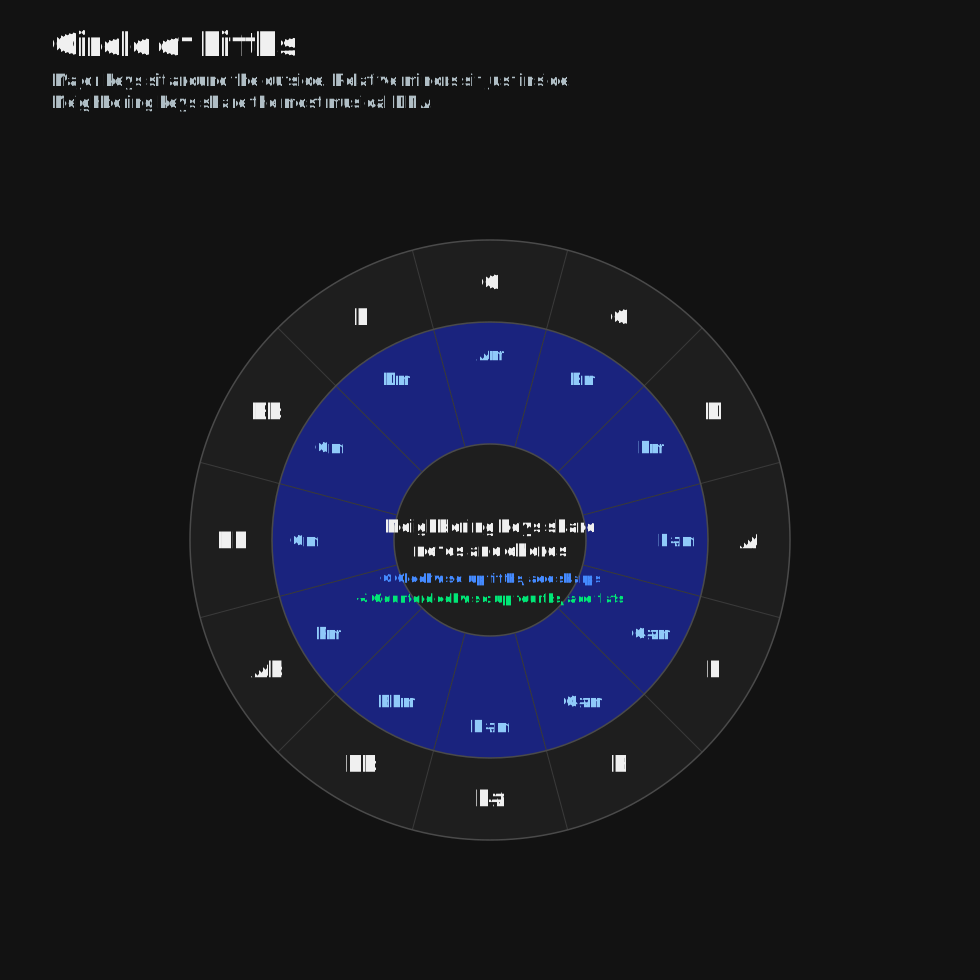
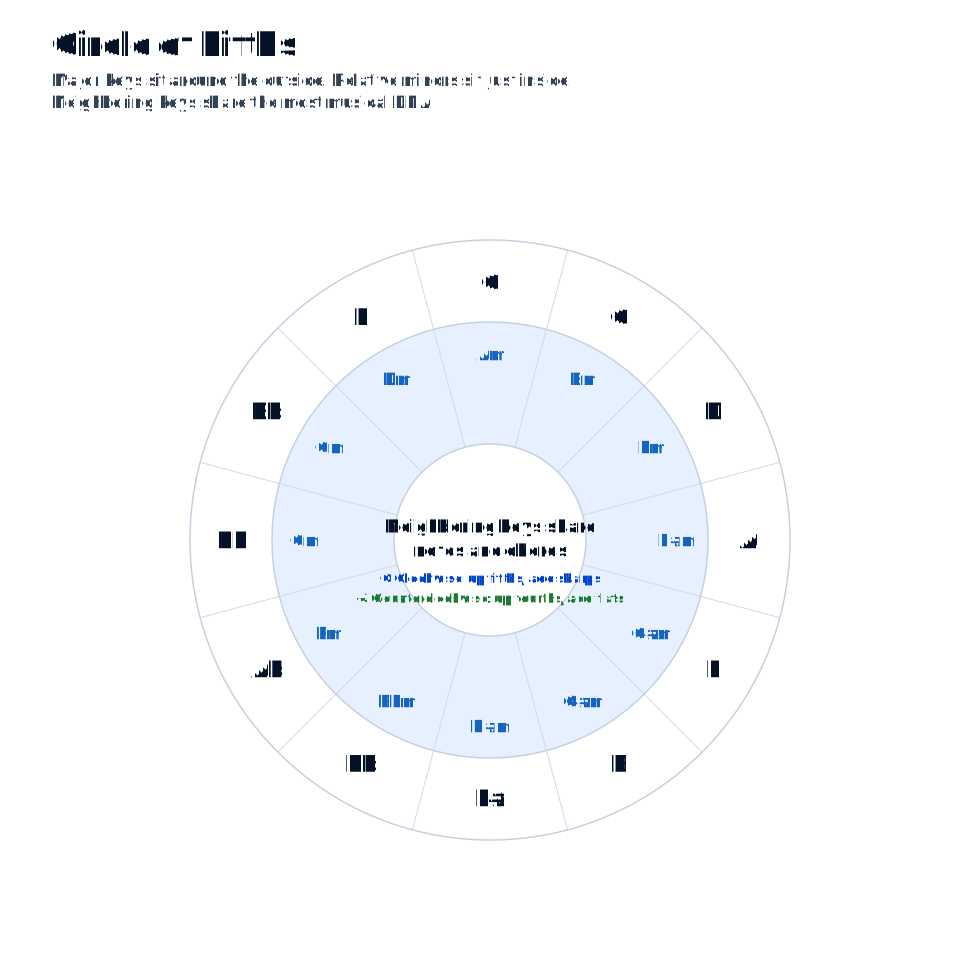
Guitar Translation
Think of the circle as a map of musical neighborhoods. Keys that sit next to each other are closely related. Keys across the circle feel more distant.
Why Fifths Sound So Strong
The interval of a fifth is one of the most stable and powerful sounds in music.
Guitar players already know this sound, even if they don't call it by name:
- A basic power chord is built around the Root Note and the
5. - Power chords put the sound of the fifth under your fingers all over the neck.
- A lot of strong chord movement in rock, blues, country, and pop follows fifth relationships!
The motion around the circle lines up with one of the most fundamental relationships in the instrument and in tonal music itself.
Tip
When you hear progressions like D - G - C or Em - Am - D - G, you're hearing the motion that lines up with the circle. And your ear recognizes that pull immediately.
Clockwise and Counterclockwise
One reason the circle matters is that it helps organize keys.
Moving clockwise:
- goes up by fifths,
- adds sharps, and
- often feels like increasing harmonic brightness or tension
Moving counterclockwise:
- goes up by fourths,
- adds flats, and
- often feels like a move toward warmer, flatter key areas
Here's a practical shorthand:
Chas no sharps and no flats- one step clockwise,
G, has 1 sharp - one more step,
D, has 2 sharps - one step counterclockwise,
F, has 1 flat - one more step,
Bb, has 2 flats
Stop! You Don't Need to Memorize All of This at Once!
Start with just C, G, D, A on the sharp side and C, F, Bb on the flat side. That small map already explains a huge amount of real guitar music.
Relative Minor
The Circle of Fifths isn't only about major keys. Each major key has a Relative Minor that uses the same notes.
Examples:
C majorandA minorG majorandE minorD majorandB minor
If that sounds familiar, it should. It's the same relationship we used in Decoding the Major and Minor Pentatonic Scales.
The circle helps you see those pairs as families:
- major key on the outside
- relative minor connected to the same note pool
That's useful when:
- understanding songs that shift between major and minor moods,
- finding related scales quickly, and
- writing chord progressions that feel connected without feeling repetitive