Making Sense of the Circle of Fifths
If the Circle of Fifths has always looked like one of those theory diagrams everyone swears is important but no one actually explains, you're not alone. The good news is that it's not really a chart about memorizing symbols. It's a map of how keys, chords, and musical motion relate to each other, and once you hear that on guitar, it starts feeling useful fast.
For a lot of players, the Circle of Fifths feels abstract because it gets introduced on paper instead of on the fretboard.
If my Decoding the Major and Minor Pentatonic Scales post was about understanding what's happening inside the pentatonic scale shapes, this one is about understanding why chords and keys pull the way they do around those scale shapes.
My goal here is to help you:
- understand what the circle is actually showing you,
- learn why moving by fifths sounds so strong in music,
- connect nearby keys to nearby chord families, and
- use the circle for progressions, songwriting, and practice.
Tip
The Circle of Fifths isn't mainly about memorizing key signatures. It's about seeing which keys are closely related, which chords want to lead to each other, and why certain progressions feel so natural.
What Is the Circle of Fifths?
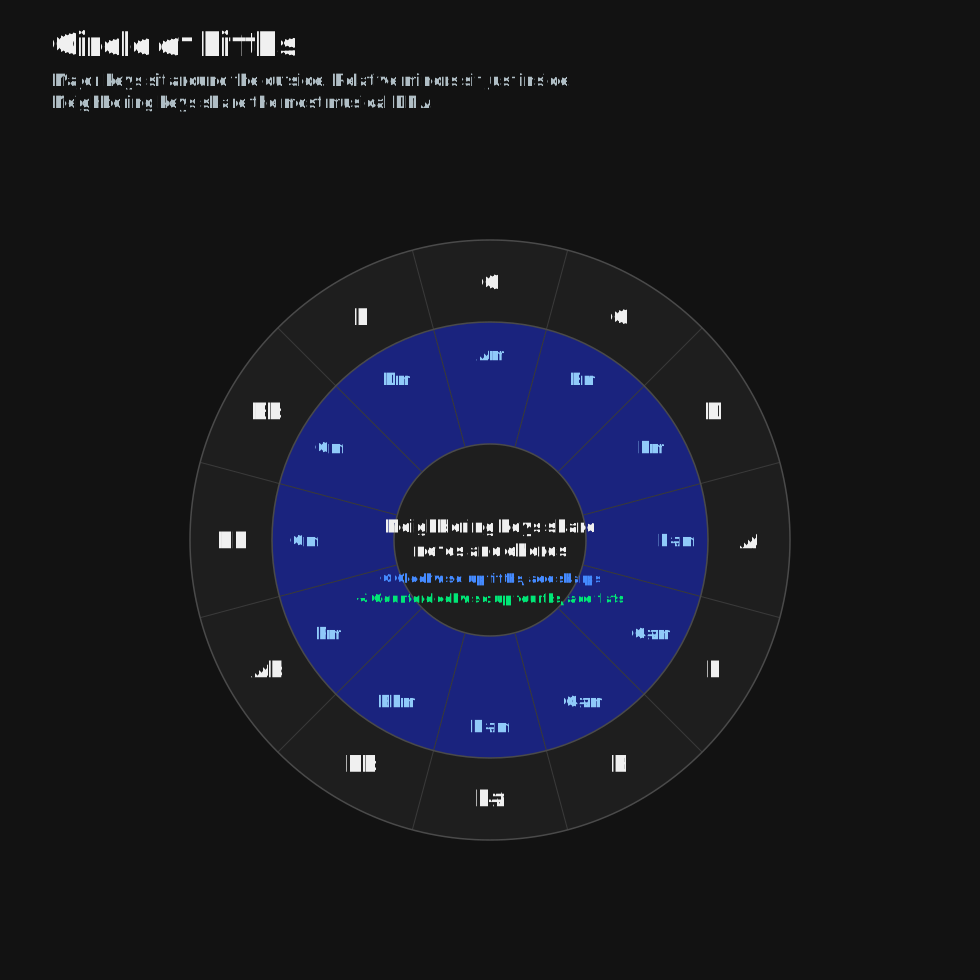
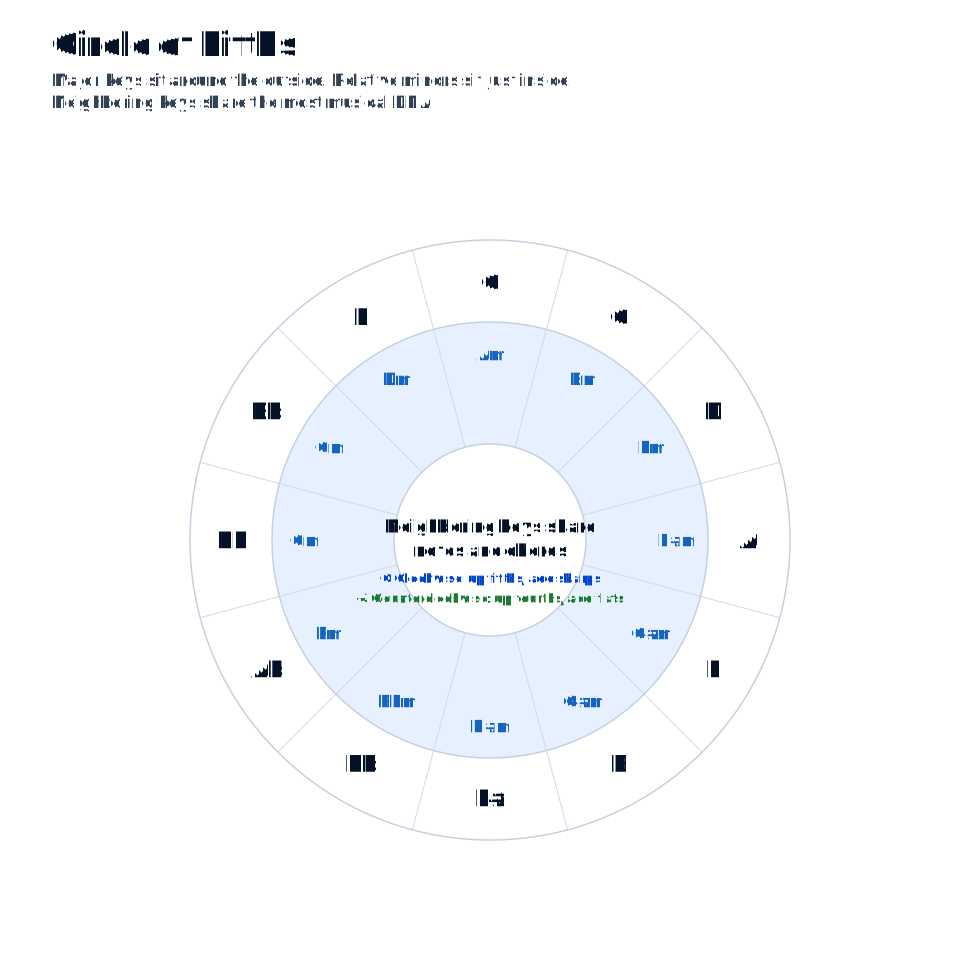
At its core, the Circle of Fifths is just an ordered list of notes.
Start on C. Move up a perfect fifth and you get G. Move up another fifth and you get D.
Keep going and you get:
CGDAEBF#DbAbEbBbF- back to
C
That's the circle.
If you move the other direction, you're moving by fourths, which lands on the same set of keys in reverse order.
"Why does that matter?"
Because music built from neighboring keys tends to share a lot of notes and chords. The closer two keys are on the circle, the more naturally they tend to connect.
Guitar Translation
Think of the circle as a map of musical neighborhoods. Keys that sit next to each other are closely related. Keys across the circle feel more distant.
Why Fifths Sound So Strong
The interval of a fifth is one of the most stable and powerful sounds in music.
Guitar players already know this sound, even if they don't call it by name:
- A basic power chord is built around the Root Note and the
5. - Power chords put the sound of the fifth under your fingers all over the neck.
- A lot of strong chord movement in rock, blues, country, and pop follows fifth relationships!
The motion around the circle lines up with one of the most fundamental relationships in the instrument and in tonal music itself.
Tip
When you hear progressions like D - G - C or Em - Am - D - G, you're hearing the motion that lines up with the circle. And your ear recognizes that pull immediately.
Clockwise and Counterclockwise
One reason the circle matters is that it helps organize keys.
Moving clockwise:
- goes up by fifths,
- adds sharps, and
- often feels like increasing harmonic brightness or tension
Moving counterclockwise:
- goes up by fourths,
- adds flats, and
- often feels like a move toward warmer, flatter key areas
Here's a practical shorthand:
Chas no sharps and no flats- one step clockwise,
G, has 1 sharp - one more step,
D, has 2 sharps - one step counterclockwise,
F, has 1 flat - one more step,
Bb, has 2 flats
Stop! You Don't Need to Memorize All of This at Once!
Start with just C, G, D, A on the sharp side and C, F, Bb on the flat side. That small map already explains a huge amount of real guitar music.
Relative Minor
The Circle of Fifths isn't only about major keys. Each major key has a Relative Minor that uses the same notes.
Examples:
C majorandA minorG majorandE minorD majorandB minor
If that sounds familiar, it should. It's the same relationship we used in Decoding the Major and Minor Pentatonic Scales.
The circle helps you see those pairs as families:
- major key on the outside
- relative minor connected to the same note pool
That's useful when:
- understanding songs that shift between major and minor moods,
- finding related scales quickly, and
- writing chord progressions that feel connected without feeling repetitive
Using the Circle of Fiths as a Guitarist
Here's where the chart becomes practical.
1. Building Chord Progressions
Some of the most common progressions in Western music move through neighboring parts of the circle.
For example:
Dm - G - CAm - Dm - G - CEm - Am - D - G
Why do these work so well?
Because each chord is pulling toward the next in a way your ear already understands.
On guitar, this shows up everywhere:
- folk progressions
- country turnarounds
- jazz
ii - V - Imotion - classic rock cadence movement
One of the Most Useful Patterns in Music
The progression ii - V - I is basically the circle in action. In C, that's Dm - G - C. In G, that's Am - D - G.
Learn that sound and you start hearing the circle all over the place.
2. Knowing Which Keys Are Closely Related
If a song is in C, the neighboring keys on the circle, G and F, are closely related.
That means they share a lot of notes and chords.
So if you're:
- changing keys in a song,
- writing a bridge,
- borrowing chords, or
- choosing a backing track to jam over
the circle clues you into which directions will feel smooth.
A simple example:
C majorcontainsC, Dm, Em, F, G, AmG majorcontainsG, Am, Bm, C, D, Em
Notice the overlap:
CAmEm
That one reason songs can move between nearby key areas without it sounding abrupt.
3. Transposing Keys
The circle also helps when you need to move a progression to a new key. That comes up more than people might admit. For example, a singer wants the song higher, a jam leader calls a different key, or you're moving a capo shape to match another guitarist.
So it's useful to stop thinking in letter names and start thinking in functions:
I - IV - VinCisC - F - GI - IV - VinGisG - C - DI - IV - VinDisD - G - A
Same shape. Same pull. Different fretboard neighborhood.
The circle tells you how big the jump feels before you play a single chord. C to G is one step clockwise. Most of the chords still live in the same family. C to F is one step counterclockwise. Same story. C to F# is across the wheel. You can still transpose there, but you're changing more harmonic color at once.
Try it with a real progression:
- in
C:Am - Dm - G - C - in
G:Em - Am - D - G - in
F:Dm - Gm - C - F
The circle shows you which chord to plug in.
On guitar, that pairs naturally with a capo. If you know a song in open G (G - Em - C - D) and need it in A, the circle tells you you're one step clockwise. Capo at the 2nd fret and play the same shapes.
You're not learning a new progression. You're relocating one you already have.
That's a much faster way to transpose than guessing chord by chord. Learn the function first. Use the circle to see how far you're moving. Then map the letters.
4. Soloing and Songwriting
The circle doesn't tell you exactly what lick to play, but it does tell you what key center you're in and what nearby harmonic moves will sound natural.
That matters when you're:
- choosing between major and minor sounds,
- targeting chord tones over a progression,
- writing a chorus that lifts, and
- writing a bridge that changes color without sounding random
Don't think of the Circle of Fifths as a poster, think of it as three practical questions:
- "What key am I in?"
- "Which chords naturally belong nearby?"
- "Where does this progression want to go next?"
If you can answer those three questions, you're using the circle of fifths.
Recommended Practices
1. Play the Circle as Root Notes
On one string, play:
CGDAE
Then reverse direction:
CFBbEb
This starts training your ear and your fretboard at the same time.
2. Loop a ii - V - I
Pick one key and use a looper pedal to record a simple progression.
Start with C major:
Dm - G - C
Then try G major:
Am - D - G
Listen for the feeling of resolution when the progression lands on the I chord. That sound is the circle becoming audible.
3. Move One Step Around the Circle
Write a simple progression in one key, then move it one step clockwise or counterclockwise.
For example:
C - Am - F - G- then try the same function in
G G - Em - C - D
This is a great songwriting exercise because it teaches you how neighboring keys feel different without feeling unrelated.
Looping Helps Here, Too!
Repetition is your friend. When you use a looper pedal to cycle a short progression, your ear starts noticing where the tension builds and where it resolves. That's much easier to hear than when you play through a whole song once and move on.
Common Mistakes
- Treating the circle like a memorization contest instead of a listening tool.
- Thinking it only matters for jazz or formal music theory.
- Assuming it's about key signatures only, instead of chord movement and harmonic pull.
- Forgetting that nearby keys share a lot of the same material context.
Don't Let the Diagram Scare You
You don't need to memorize all 12 keys perfectly before the circle becomes useful.
If you understand how C, G, D, A connect on one side and C, F, Bb connect on the other, you're already using it musically.
Once the basic circle makes sense, here are the next layers worth exploring:
- the order of sharps and flats,
- relative minor pairs in every key,
ii - V - Iin multiple keys,- borrowed chords from neighboring keys, and
- how the circle connects to modes and fretboard positions
If you want a good companion idea after this, study how Relative Major and Relative Minor work inside your pentatonic shapes. That's one of the fastest ways to connect theory to the neck.
The Circle of Fifths isn't magic, and it isn't just music theory homework.
It's a simple visualization for how tonal music moves.
Once you see it that way, it stops being a wheel of letters and starts becoming a fundamental tool for you as a musician.
You can use it to understand progressions, choose keys, write songs, transpose faster, and hear why one chord feels unfinished while the next one feels like home.
Hope that helps!