Decoding the Major and Minor Pentatonic Scales
If you've ever felt trapped inside the classic minor pentatonic box, you're not alone. The good news is that the box isn't the problem. The real breakthrough comes when you understand what the notes inside that shape are doing, and that's the moment the fretboard starts making sense.
Most intermediate players start in the same place: Minor Pentatonic Position 1, fingers parked at the 5th fret, trying to find fresh ideas out of the same old lick. While that scale shape is useful, but it can start to feel a bit clostrophobic.
My goal with this post is to help you:
- Stop seeing pentatonic scales as random patterns.
- Start seeing them as intervals, Root Notes, and musical colors.
- Learn why major and minor pentatonic scales are deeply connected.
- Use that connection to make better phrases anywhere on the neck of the guitar.
Tip
You don't need to memorize five more disconnected shapes to improve. You need to understand what your current shape is already showing you.
The word pentatonic just means five notes.
That's the whole idea:
- A major scale has 7 notes.
- A natural minor scale has 7 notes.
- A pentatonic scale trims that down to 5.
Why remove two notes?
Because the notes that are left out are the ones that create the strongest half-step tension. Whilst half-steps aren't bad, they're the notes most likely to sound tense, crunchy, or like they want immediate resolution. When you remove them, the scale becomes smoother and more forgiving.
That's why pentatonic scales are awesome:
- They're easy to hear.
- They're easy to phrase.
- They sit well over a range of chords.
- They quickly sound musical, even before your theory knowledge is deep.
On the guitar, the pentatonic scales work so well because they remove some of the strongest tension notes from the full scale. You can still create emotion and movement, but you're less likely to land on a note that feels harsh or unresolved by accident.
Why Pentatonics Feel So Friendly
By removing some of the most tension-heavy notes from the full 7-note scale, pentatonics give you a leaner set of notes that is easier to phrase with confidence. That's why they're often the first scale family guitar players truly learn to hear.
The Minor Pentatonic
The Minor Pentatonic is the sound most rock and blues players learn first. It's gritty, vocal, moody, and powerful.
Its formula is:
- 1
- b3
- 4
- 5
- b7
In A Minor Pentatonic, those notes are:
- A = Root Note (1)
- C = b3
- D = 4
- E = 5
- G = b7
This is the sound behind countless blues, rock, and lead guitar phrases. If you know the classic 5th-fret box, you already know this scale with muscle memory, even if you've mostly thought of it as a shape instead of a formula.
What gives minor pentatonic its vibe?
- The b3 gives it sadness and bluesy color.
- The b7 keeps it from sounding too polished or resolved.
- The missing 2nd and b6 remove some of the tension found in the full natural minor scale.
Minor Pentatonic Sound
If a phrase sounds smoky, tough, or like it wants a bend with some attitude, you're probably hearing the minor pentatonic personality at work.
The Major Pentatonic
The Major Pentatonic is a different flavor entirely. It sounds open, uplifting, melodic, and often a little more "singable."
Its formula is:
- 1
- 2
- 3
- 5
- 6
In C Major Pentatonic, those notes are:
- C = Root Note (1)
- D = 2
- E = 3
- G = 5
- A = 6
This is the sound you hear all over:
- country
- southern rock
- gospel
- classic pop melodies
- sweeter blues phrasing
Why does it feel so different from the minor pentatonic?
The major pentatonic contains the bright 3 and the warm 6, while the minor pentatonic contains the darker b3 and b7.
The same number of notes, but a very different emotional center.
Major Pentatonic Sound
If a lick feels open, conversational, or a little more country than blues, major pentatonic is often the sound you're hearing.
Decoding the Mystery
Here's the big secret:
- A Minor Pentatonic and C Major Pentatonic use the exact same notes.
- They also use the exact same shapes on the fretboard.
- The only thing that changes is which note feels like home.
Look at the notes side by side:
- A Minor Pentatonic: A, C, D, E, G
- C Major Pentatonic: C, D, E, G, A
Same five notes. Same fretboard map.
Different Root Note.
This relationship is called the Relative Major and the Relative Minor.
That's the mental shift most players miss.
They learn one shape and assume it only belongs to one scale. In reality, that one shape can often be heard two different ways depending on which note you emphasize, resolve to, and hear as the center.
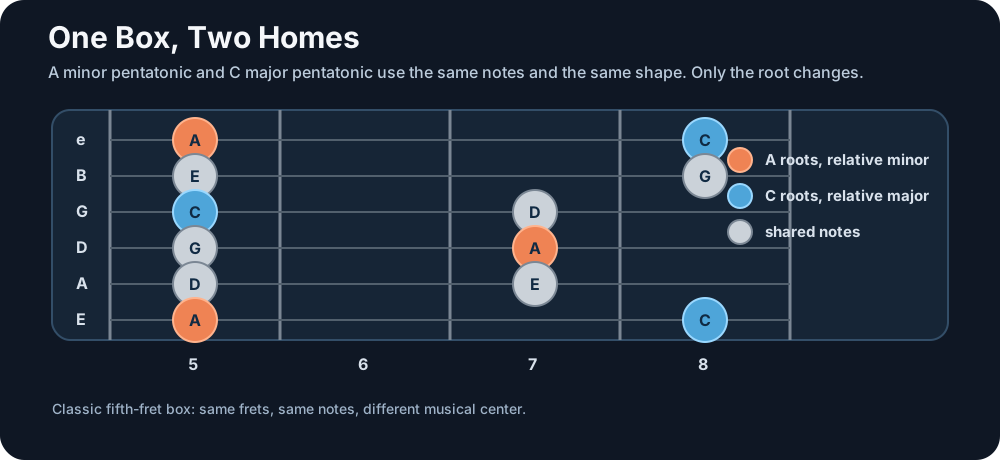
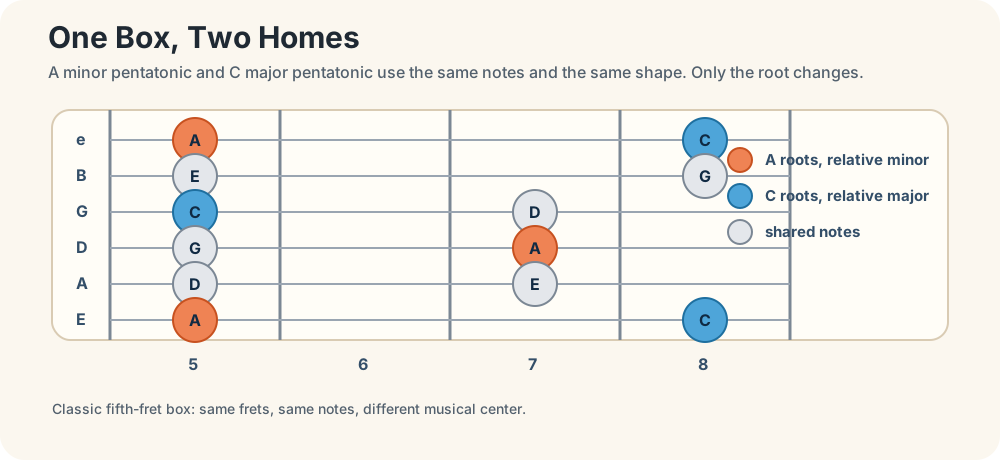
The 3-Fret Rule
This is the fastest way to find the relationship on the guitar, especially when you're using the classic minor pentatonic box most players learn first.
If you know your Minor Pentatonic root, the Relative Major root is 3 frets higher.
Example:
- Play A Minor Pentatonic with your index finger rooted on the 5th fret of the low E string.
- Three frets higher is the 8th fret, which is C.
- That C is the Relative Major.
So when you play the classic A minor box at the 5th fret:
- If A feels like home, you're hearing A Minor Pentatonic.
- If C feels like home, you're hearing C Major Pentatonic.
This is why players sometimes say, "Use the same box, just change your root."
In that one shape:
- The A notes are your Relative Minor roots.
- The C notes are your Relative Major roots.
- Every other note stays the same.
That's the visual reason the shape doesn't change, but the sound does.
Another way to say it:
- Minor to Relative Major: Go up 3 frets.
- Major to Relative Minor: Go down 3 frets.
In the classic box at the 5th fret, your index finger sits on A and your pinky reaches C, which is why this feels so immediate under your hand.
Once you understand relative major and minor, the fretboard starts looking like one connected note system.
Then you'll start to think differently when soloing:
- Where is the Root Note?
- Which note sounds resolved over this chord?
- Am I hearing this phrase as major or minor?
- Which interval am I leaning on right now?
You move from memorizing shapes to making music.
What About Positions?
Yes, positions are worth talking about, but only in the right order.
Positions are helpful because they:
- give you landmarks on the neck
- help you connect one area of the fretboard to the next
- make it easier to practice without getting lost
What positions are not:
- separate scales
- different note collections
- the real source of the sound
The better mindset is this:
- a position tells you where your hand is
- the Root Note tells you what scale sound you're hearing
- the intervals tell you why it sounds major or minor
Note
Yes, learn the positions but don't stop there. A player who knows five shapes but can't find the roots is still guessing. A player who knows one shape and understands the roots is already making music on purpose.
For this topic, it's enough to say that the same fretboard area can often be labeled differently depending on whether you're thinking in major or minor. That's why position names alone can get confusing.
A more useful question is, "Where are the roots inside this shape?"
How to Make the Same Shape Sound Major or Minor
If you stay in the same fretboard pattern, you can change the sound by changing what you emphasize.
To make it sound more minor:
- Land on the minor Root Note.
- Spend time on the b3.
- Bend into notes with a bluesy feel.
- Use a backing track centered around a minor chord or minor blues.
To make it sound more major:
- Land on the major Root Note.
- Highlight the 3 and 6 of the major sound.
- Phrase more melodically and less aggressively.
- Use a backing track centered around a major chord, country groove, or major blues sound.
Same fretboard area, but a different gravity.
Common Trap
Many players think they're playing a major pentatonic when they're really just running the same minor box without changing where the phrase resolves. The notes matter, but the landing note is what centers the key.
When to Use Each
This is where theory turns into actual playing.
As a starting point:
- use a Minor Pentatonic when the progression clearly sounds minor
- use a Major Pentatonic when the progression clearly sounds major
- use the relative connection when you want to see how one fretboard shape can serve both sounds
For example:
- over an A minor vamp like
Am - Dm - Em, resolving to A will sound natural and strong - over a C major vamp like
C - F - G, resolving to C will sound natural and strong
The important point isn't just which notes are available. It's which note sounds finished against the progression underneath you.
Find Home
If the chord progression keeps pulling your ear toward A, phrase like A is home.
If it keeps pulling your ear toward C, phrase like C is home.
Your ear should make the final call, not just the diagram.
Three Practice Moves
Here are three simple exercises that'll help.
1. One Box, Two Roots
Stay in the classic A minor pentatonic box at the 5th fret.
- First, play freely but always resolve to A.
- Then play the exact same area again, but now resolve to C.
- Listen to how the whole emotional feel changes even though your fingers barely moved.
If you want to make this even clearer, say the note names out loud as you land on them.
2. Minor Track, Then Major Track
Use two different backing tracks:
- an A minor blues or A minor rock vamp
- a C major or C country/pop vamp
Now use the same fretboard shape for both.
- Over the A minor track, make A your landing note.
- Over the C major track, make C your landing note.
This is one of the best ways to prove to yourself that the shape didn't change, only the musical context did.
3. One Shape, Different Landing Notes
Stay with the same A Minor Pentatonic / C Major Pentatonic shape and make the exercise more specific.
Try this:
- Start a phrase on A and end it on A.
- Start the next phrase on C and end it on C.
- Then mix them, but decide before each phrase whether you want it to sound more minor or more major.
What you're listening for:
- phrases that resolve to A feel darker and more minor
- phrases that resolve to C feel brighter and more major
This is a small practice move, but it trains the exact skill the whole lesson is about: hearing the same shape from two different centers.
Note
In blues, players often mix parallel major and minor pentatonic sounds over the same chord. That is a great sound, but it's a different lesson from Relative Major and Relative Minor. Master the shared-note idea first, then explore that blues color swap next.
Using a Looper Pedal
One of the best ways to practice this is with a looper pedal. Record a short progression, or even a single chord, and then solo over your own repeating loop.
Why?
- the harmony stays stable long enough for your ear to notice what feels resolved
- repetition makes the difference between major and minor easier to hear
- you can test the same phrase idea multiple ways without the progression rushing past you
A simple looper-pedal loop is enough:
- two bars of Am
- two bars of C
- or a repeating vamp like
Am - Dm - EmorC - F - G
When your looper pedal brings the phrase back around, try changing only one thing:
- end on A
- then end on C
- then keep the rhythm the same and change only the landing note
That kind of focused repetition is where the "aha!" moment usually happens. You stop guessing and start hearing why one note sounds settled while another changes the whole mood.
Practice Like a Musician, Not a Typist
Don't just run the scale up and down. Play short phrases, leave space, and listen to which note actually feels finished at the end of each idea.
A Simple Fretboard Mindset
When you practice, stop asking, "Which box am I in?"
Instead, start asking:
- Where are my Root Notes?
- Where is the b3 or the 3?
- What note am I resolving to?
- What sound does this backing track want from me right now?
Whilst the shapes are still useful, you don't need to abandon them. You just need to understand what they contain.
Where to Go Next
Once this clicks, the next step is to extend the pentatonics.
Start here:
- connect this shape to the next position up the neck
- find the same Root Notes in both positions
- make sure you can still hear which notes sound major and which sound minor
Then take the next step:
- add the two missing notes that turn the pentatonic into the full 7-note scale
- hear those notes as added color, not as a replacement for the pentatonic
- use them as passing tones and tension notes that resolve back into your strong pentatonic targets
That's where the fretboard really starts to open up. You're no longer learning "new scales" as disconnected objects. You're learning how one simple sound grows into a fuller musical vocabulary.
Tip
The pentatonic scale isn't a beginner crutch you eventually throw away. It's a core frame. The full major and minor scales simply add two more colors around that frame.
If you've spent years feeling stuck in the minor pentatonic box, don't beat yourself up. That box taught you something important: where the notes live under your fingers.
Now it's time for the next step.
Learn the intervals inside the shape. Find the Root Notes. Hear the shift between Relative Minor and Relative Major. Once that clicks, you're not trapped in a box anymore. You're navigating the fretboard with intention.
That's the "aha!" moment, and once you feel it, the whole neck opens up.